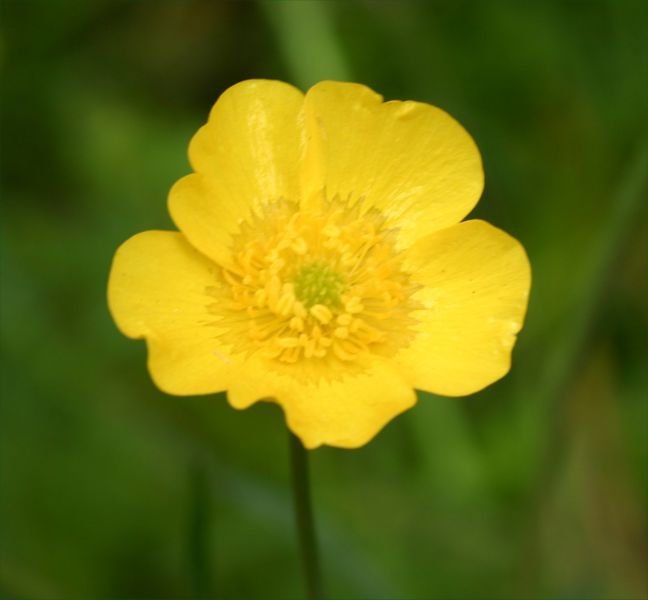
Buttercup
Giant buttercup – Ranunculus acris
Creeping buttercup – Ranunculus repens

DESCRIPTION
These are two similar perennial buttercup species commonly found in New Zealand pastures. While they have distinct growth habits, their control methods are largely the same.
Gaint buttercup forms an upright bush up to 1m tall, while creeping buttercup is lower-growing with stems that creep along the ground for up to 1m. Both produce glossy yellow flowers with five petals up to 25mm diameter at the top of erect flowering stems. Gaint butter cup flowers November-April, while creeping buttercup flowers October-February.

The leaves provide the best identification feature: Gaint buttercup leaves are deeply jagged and appear as a single leaf, whereas creeping buttercup leaves are more rounded and clearly divided into three leaflets, with the central leaflet on a short stalk.
Both species produce seeds, with gaint buttercup seeds commonly transported in hay – the most frequent source of new infestations. Creeping buttercup spreads primarily through an extensive stolon system, allowing rapid invasion of nearby areas where it typically out-competes pasture grasses and clovers.

Habitat
Buttercups are found throughout New Zealand and prefed wet conditions, making them a particular problem on:
- Dairy farms and high rainfall areas
- Poorly drained paddocks and wet spots
- Areas around water troughs and gateways
- Margins of good pasture areas
The leaves contain compounds that make them unpalatable to cattle and horses, although sheep will readily eat them. This selective grazing pressure allows buttercups to establish and spread in cattle and horse paddocks
MANUAL CONTROL
Isolated plants appearing on margins of good pasture can be successfully dug out before they invade deeper into the pasture. Complete removal of the entire root system is essential, as buttercups will regrow from rhizomes or root segments left in the soil. Manual removal becomes impractical for larger infestations due to the extensive root system and stolon network.
HERBICIDES TO CONTROL BUTTERCUP
Optimal Timing: Best results achieved during active growth periods from spring through early summer to February.
BOOM SPRAYING (PER HECTARE)
Selective Options for Pasture:
- Ranger Herbicide 20g/Ha – Very effective, against both species and docks simultaneously. Follow-up treatment likely required the following spring. Yellowing and reduced pasture vigour will occur. Complete recovery, particularly of clovers, may take up to 4 months depending on pasture condition and growing conditions.
- Decision 50g/ha (annual buttercup) or 65g/ha (giant buttercup) – Pasture and clover friendly option.
- PastureMate 3-4L/ha – Good control in seedling stage (2-3 leaves), useful suppression at later stages. Safe for grasses, clover, cereals, peas and seed crops.
- WHACK – 2,4D 800 1-3kg/ha – Controls seedling buttercup, pasture friendly with minimal clover damage.
- Rainbow & Brown MCPA 750 – Annual buttercup: 1.5-2L/ha (use lower rate on seedlings). Perennial buttercup: 2-3L/ha at early flower bud stage when plants 30-40cm high.
For Orchards/Vineyards:
- GA200 7.5-10L/ha – Effective at higher rates particurarly safe for orchard and vineyard use.
Non-Selective Options:
- G-360 GLYPHOSATE 4-5L/ha – Spray-out proip to pasture renewal or cropping.
- G-540 GLYPHOSATE 2.7-3.3L/ha
- Granny Herbicide 1.8-2.3kg/ha
SPOT SPRAYING
For spot spraying applications, our Spray Rate Conversion calculator can be used, however this is difficult with very low hectare rate products like Ranger and Decision.