Ivy
Hedera helix
Download the PDF

DESCRIPTION
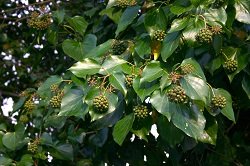
Ivy is a climbing perennial plant native to parts of Europe, North Africa and Asia. It’s a long-lived plant that spreads over remarkable distances; the stems can be 30metres or more in length! Ivy attaches to host surfaces like trees, walls and fences by means of small aerial rootlets.
The leaves are dark green and shiny, 3-15cm long, and are quite variable in shape. Ivy flowers from March to May, producing rounded, umbrella-shaped clusters of small yellowish-green flowers. The fruit appears after flowering, and is in the form of bluish-purple to black berries of about 5mm diameter. Both the berries and the leaves are known to be poisonous, although there’s no record of stock or children being poisoned by ivy in NZ.
Note: There are other types of ivy present in NZ. These include Cape ivy and German ivy, both of which, although botanically different from common ivy, can safely be treated similarly from a control point of view.
HABITAT
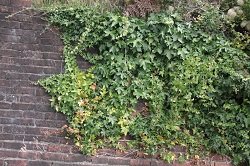
Ivy is common throughout the North Island, and also appears in parts of the South Island. It is most often found in waste areas, stream and river banks and beds, forests and plantations, roadsides and cliffs. Ivy can tolerate a wider range of conditions including damp, frost and shade. In forests it can grow to the top of even very tall trees. Ivy is subject to Pest Plant Management strategies in some regions of NZ. Check with your Regional Council for details.
MANUAL CONTROL
Isolated ivy plants can sometimes be removed by hand, though any fragments left on the site will regrow later so you’ve got to be meticulous about removing it. However, once the plant has grown over a vertical host, in particular a tree, it is extremely difficult to remove ivy without causing damage to the host. In these cases it is best to cut the stems and allow the standing parts to die off before attempting to remove them from the host tree.
WASTE DISPOSAL
Disposal of ivy waste must be done by either burning it, or sealing it in strong black plastic bags and leaving it in a sunny location to rot.
HERBICIDES TO CONTROL IVY
Cut-and-swab Herbicides to Kill Ivy
This method is very useful when the ivy has grown over a valuable host and cannot be sprayed without causing unacceptable damage. The stems are cut off close to the ground and swabbed with either of the following:
Swab immediately after cutting to ensure best penetration.
Cut'n'Paste Gels to Kill Ivy
- Glimax Professional or Bamboo Buster applied as a 4-5mm gel on the freshly cut stems is effective and easy to use.
- MetGel weedkiller gel applied as a 4-5mm gel on the freshly cut stems is effective and easy to use. It is a slower kill though.
- Picloram herbicide gel applied as a 4-5mm gel on the freshly cut stems is effective and easy to use.
Herbicides Sprays to Kill Ivy
Spraying with weed killer can be used where the ivy is spread along the ground, or over some other surface that will not be damaged by overspray. Best results will be obtained from spraying in summer. If valuable or native plants are nearby, use care and if necessary a spray shield to avoid collateral damage.
Sprays to use are:
- GrassMate – 6ml/L water. Grass or pasture friendly but can kill trees and shrubs and will damage clover.
- MSF600 – 5g/10L water. Will kill grass, clover. Can kill shrubs and trees. Metsulfuron methyl based herbicides like MSF600 are slow to kill.
In both cases you must add SuperWetter penetrant to the mix at 1ml/L water.