
OLD MAN’S BEARD
Clematis vitalba
Download the PDF

DESCRIPTION
Old Man’s Beard is a fast growing deciduous climber native to Europe. It’s sometimes confused with the NZ native Clematis and an identification guide appears below.
Old Man’s Beard forms a thick blanket of growth that is so dense that it blocks light from reaching the host tree or shrub on which it is growing, eventually killing it.
The plant has creamy-white 20mm diameter flowers with a strong fragrance, appearing December to February. The flowers are followed by the distinctive fluffy balls of seed heads, with long fluffy threads present through autumn and winter, giving the plant it’s common name.
The leaves are pale to dark green, and normally have five individual leaflets, usually heart or lance shaped. The leaves fall in autumn. The stems are quite long, strongly – ribbed (6 ribs) and purple in colour, becoming more woody and grey-brown when older. The light coloured bark on the stems is easily rubbed off.
The seeds are spread by the wind in autumn and winter, and are known to survive in the soil for several years. The seed can also be easily spread by clothing, animal fur and also by the improper disposal of cut vine material.
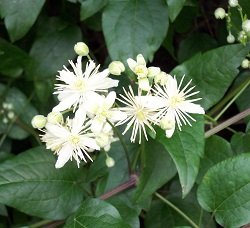
DISTINGUISHING OLD MAN’S BEARD FROM NATIVE CLEMATIS
The two principal points of difference are that native Clematis is evergreen while Old Man’s Beard is deciduous, and that the native species usually have only three leaflets per leaf, rather than the five of Old Man’s Beard.
Distribution
Old Man’s Beard was originally imported as a garden plant and was used in most settled areas in that misguided guise. Naturally it escaped, with the result that it is now a very major threat in all of the North Island, and most of the South Island.
It is a serious problem in areas of native bush, including remnant bush stands and native reserves and conservation areas.
Toxicity
There have been reports from England of cattle deaths due to having eaten Old Man’s Beard. NZ stock appear to have more sense.
MANUAL CONTROL
Isolated plants can be traced back to their base and the roots dug out. If the standing vines are too comprehensively entwined in the host tree, they may be cut off and left to die, when they are easier to remove without damage to the host. Vines trailing on the ground must be removed or they will take root.
HERBICIDES TO CONTROL OLD MAN'S BEARD
Cut and Swab Herbicides to Kill Old Mans Beard
Trace the vine back to the origin during winter and cut off at waist height and again close to the ground, then swab the fresh-cut ground level stump as below. Standing and trailing vines must be treated as for Manual Control above. The removed segments of vine (between the cuts) must be burned or buried.
- TRICLO Herbicide – 1 part to 20 parts water.
- GrassMate – 1 part to 20 parts water.
- MSF600 – 3-5g/litre of water.
- GLYPHOSATE (360 or 540) – 1 part to 4 parts water.
- GrassMate XTRA – 1 part with 20 parts of water or diesel.
Cut'n'Paste Gel Weedkiller to Control Old Man's Beard
Glimax Professional gel applied to the freshly cut stump or on the underside of the leaves if you don't want to cut them back or spray them works well
Herbicide Sprays to Kill Old Man's Beard
Spraying may be necessary where the growth is too dense to allow other treatment, but care must be taken to minimise overspray, and if the host tree is valuable or irreplaceable and can’t be reasonably shielded then avoid spraying at all.
- GrassMate – 6ml/L (knapsack) or 250ml/100L (handgun).
- TRICLO Herbicide – 6ml/L (knapsack) or 400ml/100L (handgun).
- MSF600 – 5g/10L water, plus 10ml SuperWetter penetrant.
- GLYPHOSATE – 200ml/10L water, plus 10ml SuperWetter penetrant.
- Ralid – 125ml/10L water for knapsack users, plus 10ml SuperWetter penetrant.
Note that whatever the control method used, there will always be some surviving stems or regrowth, and follow-up action will be necessary to completely eradicate Old Man’s Beard.