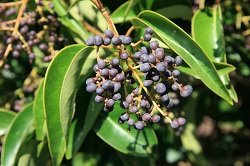
PRIVET
Ligustrum lucidum – Tree privet
Ligustrum sinense – Chinese privet

DESCRIPTION
Note: Tree privet and Chinese privet are related and very similar species. Differences between them are noted in this weed file but as they present essentially the same problems and require identical control measures, the two species are for practical purposes treated as if they were the same.
Both privet species were introduced to NZ from China as ornamental and hedging plants. Privet has since become a highly invasive pest plant, and in some regions of NZ the plant is subject to Pest Plant Management Strategies, and may not be sold, propagated or distributed.
Tree privet is a hardy, fast-growing evergreen shrub/tree that grows up to 10 metres in height. Chinese privet is similar but smaller, generally reaching only 5 metres in height.
The leaves of the privet species are a useful distinguishing feature. The leaves of the tree privet are larger (up to 13cm long), dark green and glossy on the upper surface, and generally have a sharply-defined oval shape with a pointed tip and clean edges. The Chinese privet by contrast has leaves that are smaller with a dull green upper surface, with a less-sharply oval shape and slightly wavy edges, a more rounded tip, and a hairy mid-rib on the undersurface.
Flowers are white in both species; the tree privet flowers November to March while the Chinese privet flowers from July to March.
Both species produce dense clusters of black or purple-black berries.
The fruit and leaves of both are poisonous, and are widely-held to contribute to allergies and asthma, in spite of privet being insect-pollinated and so not generating wind-blown pollen.
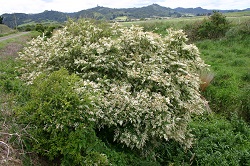
DISTRIBUTION
Tree privet occurs in the North Island only, mostly in North Auckland, Auckland and Bay of Plenty. Chinese privet also occurs mainly from Bay of Plenty northwards, but has been recorded south to Wellington and around Nelson.
The common habitat for invasive privet is around gardens, forest margins and roadsides. Both privet species will rapidly colonise waste areas or stands of trees, and will readily displace native plants in regenerating sites.
Privet spreads via birds eating the berries and then scattering them in their droppings, and also following human plantings that escape and then spread to invasive proportions.
MANUAL CONTROL
Pulling or grubbing out seedlings is effective, and should be done before any seeds present ripen. Removed material can then be mulched or composted.
HERBICIDE CONTROL OF PRIVET
Because of its heritage as a hedge, privet is often found growing wild in close proximity to horticultural and other sensitive sites where the hedges were located, so care must be taken to avoid spray drift damage to valuable adjacent plants.
Handgun Spray Herbicides to Kill Privet
- G-360 GLYPHOSATE sprayed at 1 litre per 100L water. For G-540 GLYPHOSATE use at 700ml/100L or Granny Herbicide use 450g.100L water. All with 200ml of SuperWetter penetrant added
- MSF600 at 35g plus 200ml SuperWetter per 100 litres of water.
Knapsack Spray herbicides to Kill Privet
- G-360 GLYPHOSATE sprayed at 225ml per 15L of water. For G-540 GLYPHOSATE use at 180ml/15L. For Granny Herbicide use 100g per 15L, in all cases add 30ml of SuperWetter penetrant.
- MSF600 at 5g plus 30ml of SuperWetter per 15 litres of water.
Cut stem and inject. Herbicides to Kill Privet
This is a very effective control method in situations where the size of the plant or its proximity to vulnerable valuable species makes spraying impractical. It is essential that the herbicide is applied as soon as possible after the cuts are made.
- MSF600 at 20g plus 10ml SuperWetter in 1 litre of water. Make downward cuts with machete or axe around the base of trees, cutting into the sap wood. Inject the herbicide mixture into the fresh cuts to the point of runoff.
- G-360 GLYPHOSATE or G-540 GLYPHOSATE used neat and applied as above is also effective.
Fell and Stump Swab Herbicides to Kill Privet
Where the situation allows the large privet tree can be felled entirely and the fresh cut stump liberally swabbed with the MSF600 concentrated mixture as detailed in the ‘Cut stem and inject’ section or better still use Cut’n’Paste Picloram Gel or Cut’n’Paste Glimax Professional Gel. Use the convenient applicator bottle and spread the gel evenly over the freshly cut stump.