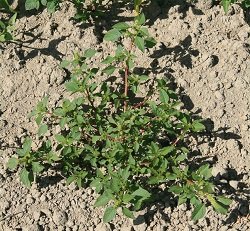
REDROOT (Amaranth)
Amaranthus powellii
Download the PDF

DESCRIPTION
There are three closely related plants that are all called redroot, and the most common is Amaranths powellii. The others are A. retroflexus and A. hybrids. And there’s a fourth that’s commonly called purple amaranth. For control purposes they can all be considered together, but this Weed File will concentrate on describing the most common of them, which is most widely called redroot, or sometimes called Prince of Wales feather.
Redroot is a summer growing annual weed. It dies off with the autumn frosts.
The plant is very leafy and grows quite tall; up to 1 metre in height in good conditions, although much less in poor sites.
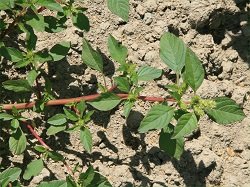
The leaves are variable in size (2-10cm), and are oval shaped. They are hairy on the under surface. Generally the leaves are green in colour, but they very often turn pink/red in autumn.
Stems are erect, and reddish in colour, especially lower down on the plant. The stems form numerous short, leafy lateral branches. These laterals remain short when the redroot is growing in a standing crop, but spread in situations where the redroot plant is isolated.
The flowers are green and quite small, growing in spikes with many short laterals. The flowers appear in the December to February period.
The fruit is formed in seed heads that can be up to 200mm long and droop from the stems. The seeds themselves are small, black to dark brown, and shiny.
The plant has, not surprisingly, a fleshy red taproot.
HABITAT
Redroot appears throughout New Zealand, but prefers warmer conditions than do many other summer annual weeds, which means it is usually most troublesome in the North Island.
It appears often in waste places and in cultivated ground, and is a particularly common unwelcome guest in crops including maize. In that situation redroot forms quite dense patches of erect plants, making it a very competitive crop invader. It does also appear in pastures, again often in dense stands.
HERBICIDES TO CONTROL REDROOT (Amaranth weed)
Redroot is readily controlled by most of the common herbicides, so the choice of what to use is really a matter of the situation in which the redroot is growing.
Herbicides to Kill Redroot in Cereal Crops
- Rainbow & Brown MCPA 50 – 1.5L/Ha in 200-300L water, boom sprayed when the weed is young and active, and when the cereal crop is between 5 leaf and jointing.
- Dicamba 500 Select – 140-280ml plus 1.0L of Rainbow & Brown MCPA750 in 100-200L water per hectare.
For linseed and grass seed crops, use Rainbow & Brown MCPA750 as above, but at just 0.75-1L/Ha, and when the weed is as young as possible and actively growing.
Weedkillers to Kill Redroot in Pasture
- PastureMate – 3-4L/ha in 200L of water. Good control in seedling stage (2-3 leaves) and useful suppression at later growth stages. Safe to use in new and established pasture (grasses and clover).
- Rainbow & Brown MCPA750 – 1.5L/Ha in 200-300L water on actively growing redroot seedlings at the 4-6-leaf stage.
- WHACK – 2,4-D 800 – 1.-1.5kg/Ha for a 680g/L active formulation to redroot at the small plant stage (at the time of writing WHACK – 2,4-D 800 product in registration; watch for it soon!)
- Dicamba 500 Select – 100ml plus 260ml Rainbow & Brown MCPA750 in 100L water per hectare.
- Dicamba 500 Select – 120-140ml plus 535ml WHACK – 2,4-D 800 per 100L water per hectare.
- WHACK – 2,4-D 800 – 1-1.5kg/ha for seedlings and 1.5-2kg/ha for small rosettes.
Note that both Rainbow & Brown MCPA750 and WHACK – 2,4-D 800 will suppress clover in pasture. Dicamba 500 Select will kill clover.
Spot Spraying Herbicides to Kill Redroot
• GrassMate – 6ml/L of water used in a knapsack or other hand sprayer.
Non-Selective Herbicides to Kill Redroot in non-cropland areas
- TerbGuard 500 – Broadcast application at 15 – 19L/ha in 150 – 300L water. Add G-360 GLYPHOSATE, G-540 GLYPHOSATE or Granny Herbicide at the recommended label rates. TERBUTHYLAZINE 500 IS NOT SUITABLE FOR PASTURE OR CROPLANDS.