SHEPHERD’S PURSE
Capsella bursa-pastoris
Download the PDF

DESCRIPTION
Shepherd’s purse is a small short-lived annual weed found throughout New Zealand. It germinates readily at most times of the year, including in winter if the growing conditions are at all reasonable and moisture is sufficient. Because of this ability Shepherd’s purse can thrive in conditions where the growth of other competitive summer annuals is inhibited, and thus it can often become more noticeable in winter.
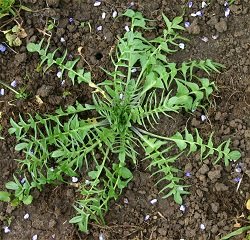
The plant initially takes the form of a small rosette, growing quite flat to the ground, and because the leaves at that stage are variable in form it can be difficult to identify it as Shepherd’s purse in the vegetative stage. The rosettes tend to be only 10-15cm in diameter.
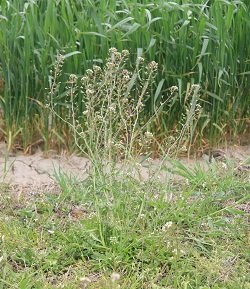
However, the plant does soon put up a tall flower stem from the centre of the rosette, and this will usually reach 20-30cm in height, making the weed easier to see and identify. The stems form into several spreading branches, and support small white flowers of about 3mm diameter, each with four small petals. Flowering is usually seen from September to January.
The flowers are followed by the formation down the upper parts of the stems of large numbers of seed pods, which are heart-shaped (or purse-shaped, if one can imagine a shepherd carrying a purse). These pods split when ripe to release large numbers of the plant’s very small brownish seeds.
HABITAT OF SHEPHERD’S PURSE WEED
Shepherd’s purse appears most commonly in cultivated ground, crops, gardens, waste areas and on bare ground. The plant is susceptible to white rust fungus, with which it is often infected.
HERBAL REMEDY
Shepherd’s purse is said by herbal lore to be an efficient way to stop bleeding, both externally an internally. It is also said to be a traditional remedy for jaundice, when tied to the wrists or the soles of the feet. Rainbow & Brown makes no warranties about the efficacy of these remedial uses of the plant, especially the one about tying bunches of it about your wrists and feet. But if you do, please send us a picture for the newsletter.
HERBICIDES TO CONTROL SHEPHERDS PURSE WEED
Shepherd’s purse is tolerant or resistant to several common herbicides, and is particularly resistant to most of the selective types including picloram, clopyralid and dicamba.
However, it is controlled well by some of the rather simpler (and less costly) herbicides.
Spot Treatment Weedkillers to Kill Shepherds Purse
Individual plants are easily killed by the most common of non-selective herbicides:
- G-360 GLYPHOSATE – 100ml/10L water, plus 10ml SprayWetter penetrant.
Spot spraying with a selective herbicide such as
- WHACK – 2,4-D 800 – 50ml/10Lplus 10ml SprayWetter penetrant. Will protect nearby grass and clover
- WHACK – 2,4-D 800 -1-2kg/ha for seedlings and small rosettes.
Spraying in Crops to Kill Shepherds Purse
- Rainbow & Brown MCPA750 – 1.5L/Ha plus 100ml of SprayWetter penetrant per 100L water.
- WHACK – 2,4-D 800 – 1.5-3.kg/ha.
- Dicamba 500 Select – rate varies depending upon the crop and may perform better in some situations when mixed with Rainbow & Brown MCPA750 or WHACK – 2,4-D 800. Read the Dicamba 500 Select Product leaflet for exact rates. This will kill clover.
Spray Herbicides to Kill Shepherds Purse in Pasture
- Dicamba 500 Select - 100ml plus 260ml Rainbow & Brown MCPA750 in 100L water per hectare.
- Dicamba 500 Select - 120-140ml plus 535ml WHACK – 2,4-D 800 per 100L water per hectare.
- WHACK – 2,4-D 800 – 1-2kg/ha.
- Rainbow & Brown MCPA750 – 1.5L/Ha plus 100ml of SprayWetter penetrant per 100L water.
Note: Cultivation will also readily kill existing Shepherd’s purse plants.
Non-Selective Herbicides to Kill Shepherds Purse in non-cropland areas
- TerbGuard 500 – Broadcast application at 15 – 19L/ha in 150 – 300L water. Add G-360 GLYPHOSATE, G-540 GLYPHOSATE or Granny Herbicide at the recommended label rates. TerbGuard 500 IS NOT SUITABLE FOR PASTURE OR CROPLANDS.