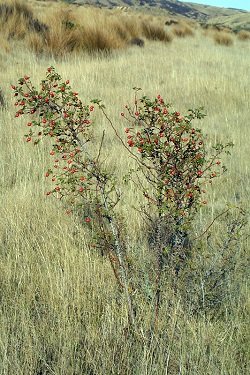
SWEET BRIAR
Rosa rubiginosa
Download the PDF

DESCRIPTION
Sweet briar (sometimes spelled as sweet brier) is a very serious problem in large parts of the South Island, and a lesser problem in the North Island. It is subject to Pest Plant Management Strategies in several regions of New Zealand.
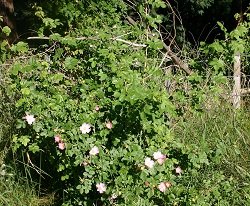
It is a woody, deciduous shrub, a perennial, and grows to about 3 metres in height. It has the appearance of an ornamental rose, and that is in fact where it came from; an escapee from gardens and ornamental hedges.
The sweet briar has pink rose-like 40mm diameter flowers, growing in clusters of one to three blooms through the summer months, followed by bright red 20mm long rose hips, which are actually the seed pods and contain many seeds.
The stems of the shrub are woody and often arching, rather like a blackberry, and have many downward-curving sharp thorns.
Sweet briar’s leaves are a bright light green colour, divided into 5-7 leaflets (again, similar to blackberry), but spread along the stem rather than in clusters like blackberry. The upper leaf surface is smooth, the underside is hairy, and the leaves have a distinctly sweet smell.
The root system of the sweet briar is stout and branched, and often throws up suckers.

HABITAT
In the South Island, sweet briar has attained very serious weed status in Central Otago and some of Canterbury. It favours dry, tussocky grasslands. In the North Island, the plant is most commonly seen on roadsides, in riverbeds, and in drier grasslands towards the east coast.
It is spread by cattle, possums and birds eating the rose hips (seed pods), though it is as a seedling a poor competitor, and tends to survive at that stage only in conditions where pasture is poor and sparse due to stony soil and low rainfall. However, once a plant is established it becomes a strong competitor, and it thrives.
LIVESTOCK
Goats will happily eat sweet briar, and can be successfully bring infestations under control. Nothing else will eat it.
MANUAL REMOVAL
Individual sweet briar shrubs can be dug out. Remove all fragments of both roots and stems, because it will readily re-grow from fragments of this material.
HERBICIDES TO CONTROL SWEET BRIAR
Spray sweet briar during the summer months, after reasonable leaf emergence but ideally by the green rose hip stage. This will normally be from November to February, though when using MSF600 the autumn period can be extended by a month or two as long as the plant is still actively growing. In all cases thorough spray coverage is essential for good results.
- GrassMate – 500ml/100L by handgun, or 10L/Ha by air or ground boom. Add SuperWetter – 100ml/100L water for ground use, and 200-300ml/100L for air use. GrassMate is pasture grass friendly but will kill clover.
- MSF600 – 35g/100L by handgun, or 170g/Ha by air. Add SuperWetter – 100ml/100L water for ground use, and 200-300ml/100L for air use.
- Granny Herbicide – 425g/100L by handgun (G-360 GLYPHOSATE – 1L/100L or G-540 GLYPHOSATE – 660ml/100L). By air or ground boom spray use Granny Herbicide – 5kg/Ha by air or G-360 GLYPHOSATE – 12L/Ha, or G-540 GLYPHOSATE – 7.9L/ha. Add SuperWetter at 100ml/100L water for ground use, and 200-300ml/100L for air use. You can also add Foam Crusher anti-foam.
- GrassMate XTRA – 300ml-500ml/100L by hand gun or 12L/Ha by air.
Both MSF600 and the glyphosate based products will kill pasture grass. MSF600 will kill clover and the glyphosate based products will knock clover back and at the higher rates may kill it.