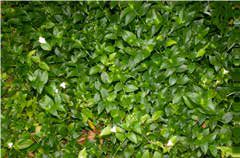
WANDERING JEW
Tradescantia fluminensis

DESCRIPTION
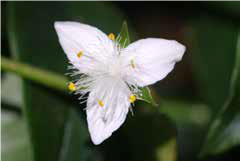
Wandering Jew (also known as Tradescantia or Wandering Willie) is a low-growing, creeping perennial weed from South America, formerly sold as an ornamental but now banned from garden centres due to its invasive nature. It forms dense mats of soft, fleshy stems with shiny oval leaves (3 - 6 cm), rooting at the nodes wherever stems contact the soil. Small white three-petalled flowers appear in spring–summer. It rarely sets viable seed in New Zealand and spreads almost entirely through stem fragments.
Mats reach 30–50 cm thick, suppressing pasture, lawn, ornamental, and native seedlings. Contact with foliage can cause allergic skin reactions in dogs and other animals. Once established, it is very difficult to eradicate.
Spread occurs via:
- Stem fragments moved by mowing or slashing
- Garden waste dumping
- Floodwaters carrying fragments downstream
- Machinery, vehicles, and footwear Stems are brittle and do not dry out readily — even tiny fragments can regrow.
Habitat
Common throughout New Zealand — particularly the North Island — in moist, sheltered locations. Prefers shade but persists in partial sun once established.
Commonly found in:
- Native bush margins and forest remnants
- Stream banks, drains, and damp gullies
- Shaded fence lines and shelter belts
- Garden beds and under trees
MANUAL REMOVAL
Manual removal is only suitable for very small infestations. Plants are shallow rooted but any remaining fragments will regrow rapidly. All removed material must be buried deeply (30–50 cm) or dried and burnt - do not compost or mulch - stem nodes survive composting. Not practical for large infestations.
HERBICIDES TO CONTROL - OUR SPECIALITY
Spraying is the preferred method for controlling larger infestations of Wandering Jew
Optimal Timing
- Treat during active growth
- Spring through early autumn (warm conditions best)
- Repeat applications are commonly required
SPOT SPRAYING OR KNAPSACK
Lifestyle blocks, gardens, reserves
*preferred option* TRICLO Herbicide 60mL + SuperWetter at 10mL per 10L water. This is the most effective option with rapid brown-out and best applied during warmer months (approx. Oct – March).
Glyphosate options (use where soil residues are undesirable or near waterways):
- G-360 Glyphosate 360 200mL + SuperWetter at 10mL per 10L water
- G-540 Glyphosate 540 130mL + SuperWetter at 10mL per 10L water
- Granny Herbicide 90g + SuperWetter at 10mL per 10L water
Note: Glyphosate options are best when you don’t want any soil residues, and when you are spraying close to waterways (say 5 metres). Do not spray directly into water. Control is slower than TRICLO and regrowth is more likely, so follow-up spraying should be expected.
- MSF600 + Glyphosate MSF600 at 5g + G-360 Glyphosate 360 at 100mL + SuperWetter at 10mL per 10L water. This is more effective than glyphosate alone with reduced regrowth. Do not use near waterways, as MSF600 can damage aquatic plants even at very low concentrations.
Combination treatments
Combining TRICLO Herbicide with G-360 Glyphosate 360, G-540 Glyphosate 540, or Granny Herbicide in a single spray has shown excellent results in difficult infestations, based on customer experience.
BOOM SPRAYING
Farm margins, reserves, contractor application
Apply the above products at equivalent per-hectare rates based on spray volume. Ensure thorough coverage of the mat surface, as dense growth can shield lower foliage. Repeat applications are often required.
CUT STUMP / GEL APPLICATION
Fence lines, garden beds, individual plants
Cut’n’Paste Glimax Professional or Cut’n’Paste Bamboo Buster Apply a 4 - 5 mm bead of gel to the freshly cut stem or stump. Effective and easy to use where spraying is impractical. Commonly used in gardens, bush margins, and sensitive areas.
Important Notes
- Complete spray coverage is critical
- Dense mats often require repeat treatment
- Do not mow or disturb treated areas until fully dead
- One or more follow-up applications are usually required to fully eradicate regrowth