WILD CARROT
Daucus carota
Download the PDF

DESCRIPTION
Wild carrot is sometimes called carrot weed, but that same moniker, ‘carrot weed’, is even more commonly misapplied to parsley dropwort, which is a different species that just looks a bit similar. We have a separate Weed File on parsley dropwort, available on the Rainbow & Brown website.
But we’re talking now about the real wild carrot, Daucus carota. The familiar garden carrot, that Bugs Bunny and we eat, is just a selectively bred descendant of this same wild carrot plant. And that’s the easiest way to tell the difference; parsley dropwort has fibrous roots with small dark tubers, while wild carrot has a slender white taproot and it smells exactly like … a carrot!
One other source of confusion. Wild carrot is also sometimes confused with an unpleasantly poisonous bugger called hemlock. The problem is that all the above species have superficially similar above ground appearance, including white flowers growing on stalks in a spray of clusters called umbels (i.e. umbrella-like).
But the root, and of course its smell, distinguishes genuine wild carrot from the others.
Had Socrates inspected and sniffed the root before scoffing hemlock, he’d probably still be with us today!
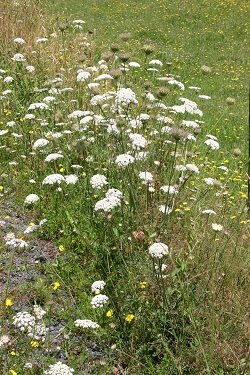
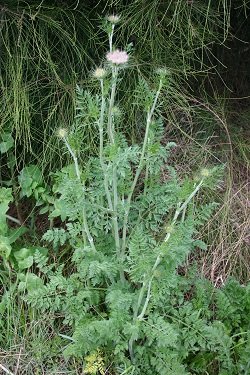
Wild carrot is an annual or biennial. It’s an upright plant, growing to about a metre or a bit more in height. The leaves are fern-like, with individual segments being about 20-40mm long. Not surprisingly, the leaves look much the same as a garden carrot.
The white flowers appear, often in a spectacular though dismaying cloud of white, from August to May. They grow on tall, ridged stems that are branched, and have bristly hairs.
The fruit is egg-shaped with wee hooks that make it easy for stock to unwittingly disperse wild carrot in their travels.
HABITAT
Wild carrot is very common in the North Island of NZ, and in the north and east of the South Island. It’s a particularly common roadside plant, a fact that’s easily noticed when wild carrot’s in flower. It also appears in waste areas, cultivated land, and in gardens. And, alas, in pasture as well.
MANUAL REMOVAL
Individual plants are easily removed manually, but wild carrot usually becomes evident as a problem when it’s got past the individual plant stage, and is more of a mass threat. So in most cases, spraying is the more practical choice.
HERBICIDES TO CONTROL WILD CARROT WEED
- WHACK – 2,4-D will control seedlings, but only seedlings, when applied at a rate of 2.5kg/ha
- Rainbow & Brown MCPA750 will very likely do the same (it controls the similar parsley dropwort well at seedling stage) and might be the better choice if the paddock has lots of buttercup as well.
- G-360 GLYPHOSATE, G-540 GLYPHOSATE or Granny Herbicide will also kill wild carrot at any stage of growth but this is obviously not a pasture friendly option so you would only use if spraying out your pasture of able to use in a Weed Wiper for selective control.
- TRICLO Herbicide - here’s another possibility, though it’s ‘off-label’ at the moment. Various USA agricultural authorities recommend, for all growth stages, a herbicide with the active ingredient triclopyr. That’s the active in our own product TRICLO Herbicide; a product that is grass friendly, though it damages clover. The rates they suggest would equate to 7L/Ha of our TRICLO Herbicide weed killer, but we doubt that the rate would need to be that high in NZ pastures during active growth. So if you’re spraying something else with TRICLO Herbicide and there’s wild carrot present, please let Rainbow & Brown know the rate you used, the growth stage of the wild carrot, and the effect observed. If it’s promising, we’ll do trials to support a new label recommendation.