
WOOLLY NIGHTSHADE
Solanum mauritianum
Download the PDF

DESCRIPTION
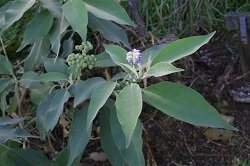
Also known as tobacco weed, flannel weed and kerosene plant, woolly nightshade is an invasive plant that can quickly form dense stands, squeezing out all competing plants. It appears as a shrub or small tree, growing up to about 10m high and 200mm trunk diameter.
The leaves are large, oval shaped, grey-green and furry on the upper surface (hence ‘woolly’ nightshade & ‘flannel’ weed), and smell strongly of kerosene especially when crushed (hence ‘kerosene’ plant). The leaves are white or yellow-green underneath. At the end of the branches it has clusters of 20mm diameter purple flowers that become berries, initially green but subsequently ripening to yellow in colour. These are spread mainly by birds. A single mature plant can produce 100,000 viable seeds in a year.
Caution: This plant is thought to be poisonous to stock, and is known to be moderately toxic to humans, especially children. When handled the plant gives off a dusty substance that is irritating to the eyes, respiratory system and skin.
MANUAL & MECHANICAL REMOVAL
Physical removal of woolly nightshade plants can be effective where it’s practical. Methods can range from hand pulling of smaller plants and seedlings, to slashing, crushing, bulldozing and mechanical digging. The size of the plants, the terrain, the density of the stands and the possible need to preserve adjacent native plants will determine which method (if any) is most suitable for any situation.
When entire plants are removed manually, shake all soil from the root mass and leave it on site.
REGROWTH
All the physical removal methods will leave viable stumps and/or root fragments that will regrow if left unattended. It’s therefore essential to chemically treat any remaining stumps (see below), and to be prepared to spot-spray regrowth seedlings. Regrowth can be minimised if desirable species (e.g. rye/clover or native species as appropriate for the situation) are planted in the sites from which woolly nightshade has been freshly removed. This will inhibit subsequent woolly nightshade seed germination on the site.
HERBICIDES TO CONTROL WOOLLY NIGHTSHADE
Larger plants are best treated individually (stem cut & inject or stump swabbed), and can be treated anytime the plant is actively growing. Smaller plants and infestations too dense for individual treatment can be successfully sprayed.
Weed Killers to Cut and Inject to Kill Woolly Nightshade
- GLYPHOSATE used neat (i.e. undiluted).
- GrassMate used neat.
- GrassMate XTRA inject 1.5ml in each cut.
Cut & Inject is suitable for large plants (stem diameter 50mm or more) found in bush blocks or forestry plantations. The plant is killed standing, which allows easier detection of and access to any seedling regrowth for later treatment. Use a machete to ringbark the stem with a full collar of overlapping downward cuts below the lowest branch. Inject either GrassMate or GLYPHOSATE to the point of runoff into each cut, using a syringe gun.
Cut Stump Herbicides to Kill Woolly Nightshade
- Glyphosate 360 at 200ml/L water.
- Glyphosate 540 at 130ml/L water.
- Granny Herbicide – 90 g/L water.
- GrassMate – 50ml/L water.
- TRICLO Herbicide – 50ml/L diesel (keep mixture agitated).
- GrassMate XTRA 1 part GrassMate XTRA with 20 parts of water or diesel.
- You can easily cut and treat the cut stems with Cut'n'Paste Picloram Gel. Hold the bottle of Cut'n'Paste Picloram Gel upside down, squeeze gently and apply 4-5mm thick coating on the cut surface.
Suitable for cutting & treating smaller plants, and for stumps remaining on sites where all vegetation has been removed by mechanical means. Stumps should be no higher than 50mm above ground, and treated as soon as possible after cutting. Use a paintbrush or other swab to totally cover the top and sides of the stump down to ground level. Add SuperWetter – 10ml/L water to aid penetration.
Spray weedkillers to get Rid of Woolly Nightshade
- GrassMate – 25ml/10L water for hand spraying, or 10L/Ha by air.
- TRICLO Herbicide – 60ml/10L water for hand spraying.
- GrassMate XTRA – 250ml/100L water by hand gun or 10L/Ha by air.
Apply when the plants are actively growing (usually October to February). Add SuperWetter organosilicone wetting agent to boost herbicide performance.
Note: If spraying dense stands of gorse or other brushweeds with MSF600 and some woolly nightshade is also present, add GrassMate to the spray mix.